Who is someone in schools that interacts with most, if not all, the students in school? You see them at least once a day, and they provide something essential. The first thing that comes to mind is usually a teacher or even a security staff member. But it is actually the kitchen staff in the cafeteria. They interact with the majority of the student body during lunch or breakfast time. The kitchen staff are often overlooked, but in reality, they actually do more than you think they do.
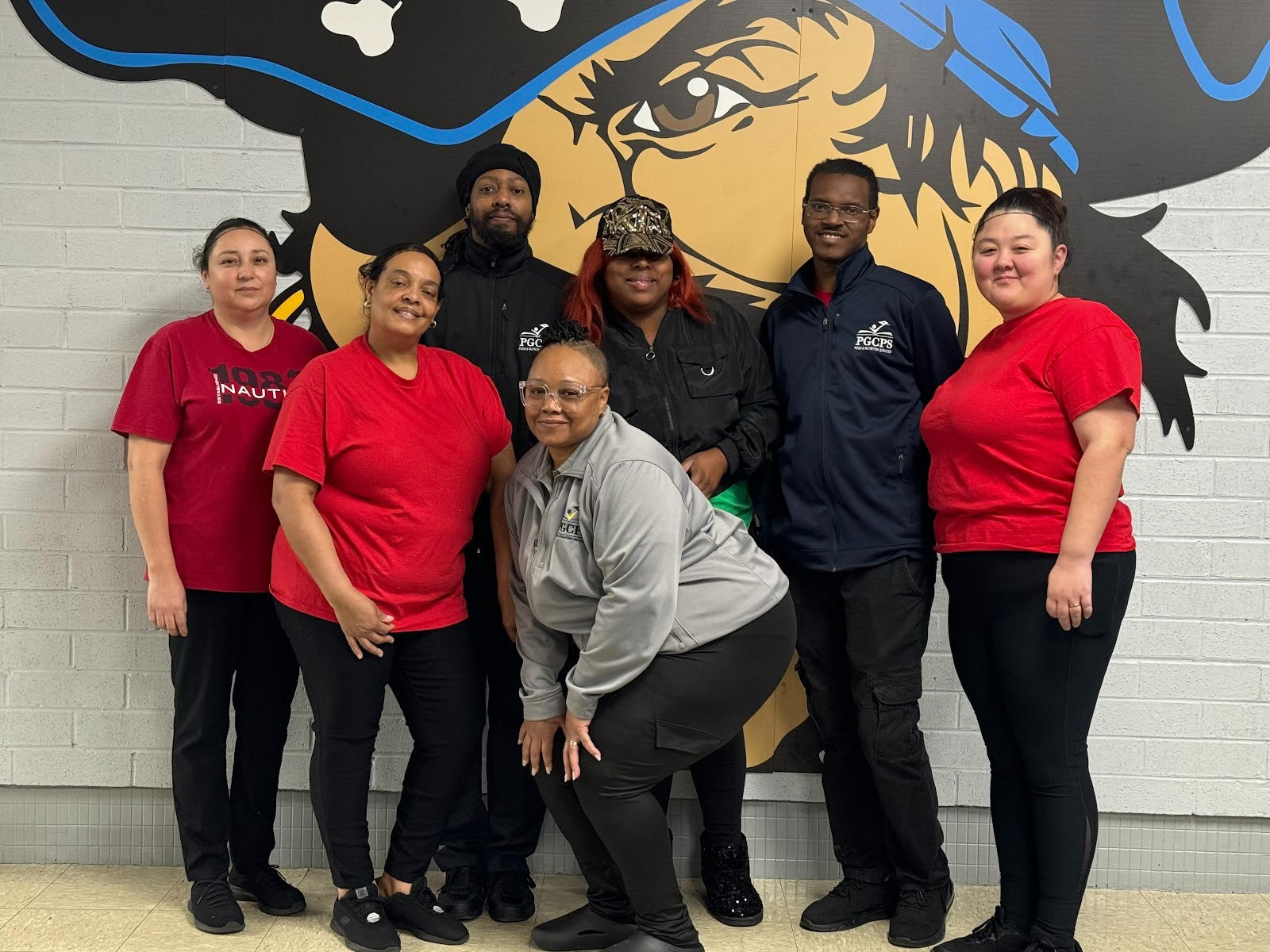
Front Row: Ms. Angelica, Ms. Alisa, Ms. Lashawn Grant
Back Row: Mr. Stephon, Ms. Monique, Mr. Devon Summers, Ms. Daniella
Cafeteria Manager, Ms. Lashawn Grant, has been the cafeteria manager for 12 years, but has been in the county for 27 years. For Ms. Grant, learning the kitchen is a rewarding experience for her, as long as she has staff that’s “willing to get along and work as a team.” Her favorite part of her job as Cafeteria Manager is “being able to feed the kids nutritious meals, and being able to engage with staff and students.” During lunch, Ms. Grant makes sure that everyone is doing their assigned assessment, like prepping the sandwiches, salads, fruits, vegetables, and main entrees. When it’s not lunch or breakfast time, she is busy behind the scenes “doing payroll, checking in on [her] other schools, and placing or receiving orders.” Ms. Grant believes that a common assumption people make about the kitchen staff is that people “see [them] as being mean.” Ms. Grant wants everybody to know that “school lunch is a very important meal of the day.”
Food Service Assistant, Mr. Devone Summers, has been a Food Service Assistant for 10 years. For breakfast, his routine consists of coming in, setting up the lines, and getting ready to run the computers. For lunch, they usually prepare that food a day in advance, but he puts the food in the oven and records the temperature, and makes sure the food is ready to serve to students. Outside of lunch or breakfast, Mr. Summers “take[s] time to clean up equipment, sweep floors.” He finds the work he does to be “fun, easy work as long as you make sure the food is up to standards, and everything is where it is supposed to be.” Mr. Summers’ favorite part of his job is getting to meet and talk to all the students, ensuring they have a nice and nutritious lunch. He also adds “cooking is fun” too. Mr. Summers notes that a common assumption is that “most people think that someone working in the kitchen means they don’t know as much and don’t have degrees, but you never know and choose to work in the kitchen.” Lastly, Mr. Summers wants everyone to know that he is “the best person back here.”
Ms. Monique has been a kitchen staff member for 21 years. Her main role as a kitchen staff member is the cashier, but she pretty much does everything. She helps set up the line for lunch and breakfast, opens the doors, and when the students come in, “we feed them.” When it is not lunch or breakfast time, she sometimes “help[s] other people with their jobs” or “start something for the next day” or “check in with co-workers, play music” or “go on break”; it really depends on what time allows. Working in the kitchen “depends on what is on the menu. Sometimes it can be rough, sometimes it can be easy.” She states that “holiday foods can be hard because of all the food, but regular food is a bit easier to prepare.” Her favorite part about her job is “talk[ing] to the children, serving the children,” but, if anything, “[she] likes to have fun no matter what.” Ms. Monique mentions that people sometimes think all schools have the same cafeteria because “children come in and say that ‘my old school does this and that’ and it is not the same because it depends on whether the old school is doing what they are supposed to be doing.” She also notes that people “sometimes think all cafeteria workers are mean.” She wants students to know that “if they tell you to grab all their items, grab EVERYTHING because we get in trouble if they don’t.” Ms. Monqiue also wants students to “be respectful to each other in line and not cut in line.” Having students ready to go as soon as they get their food is the most important and ideal process they want to ensure. So Ms. Monique wants students to “check your fund if you have to pay for lunch”, and make sure you “remember your [lunch] pin.” She also suggests that “all schools should have a staff monitoring line to cut down on all the line cutting.”
Senior Allison Gonzalezvilchis shares her thoughts, noting she believes that a kitchen staff “is responsible for prepping the school lunch, serving it, and making sure the kitchen is running smoothly.” Throughout her four years, she has said her experience has been good. “Overall, they’re really nice if you’re nice and respectful. Like saying thank you or good morning,” she remarks. Gonzalez feels like “they’re not appreciated enough and often have to deal with students that don’t appreciate the work they do.” A common assumption, she thinks, is that “their work is easy and low-skilled required. But if someone with no experience would be placed to run the cafeteria kitchen they would struggle.”
The cafeteria kitchen staff is an essential part of the Eleanor Roosevelt community. They all work hard to provide students with nutritious meals, including breakfast and lunch. Their daily routine is demanding, involving everything from advanced prepping to managing payroll and engaging with hundreds of students. It is A LOT of work behind the scenes. So remember, to show your appreciation and respect their hard work, because these heroes without capes are dedicated to keeping you fed and nourished.