

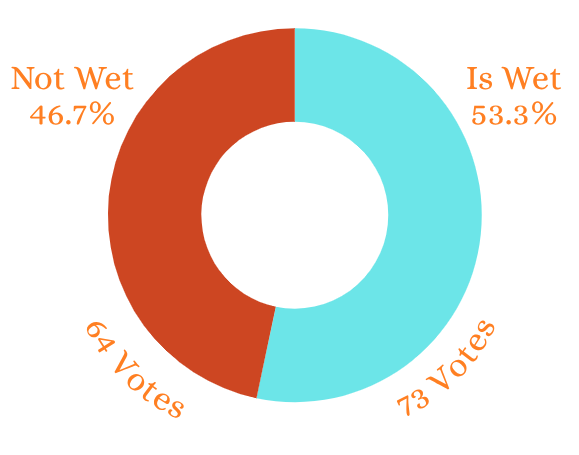
On Tuesday, November 4th, ERHS Raiders might have noticed the “Speak Your Mind” student polling cart in various locations around the school, posing a peculiar question: Is Water Wet? Popularized by online debate over the past couple of years, most raiders held firm views on the answer to the question, but what is the consensus here at Roosevelt, and how do the two sides support their beliefs?
In just under two hours of polling, 137 students from various grade levels cast their vote in ballot boxes. Participants were encouraged to share the reasoning behind their response to journalists at the polls, earning a sticker or candy as a reward. The synthesized ideas of these responses formed the basis of the two sides of the debate explained below. In the end, water being wet won at the polls with 53.3% of the vote, just 9 votes above the alternative.
How water isn’t wet
The “non-wet” opinion uses definitions of wetness like Oxford Languages’ “the state or condition of being covered or saturated with water or another liquid,” arguments of comparison, and scientific reasoning.
A major argument (and Gemini AI Summary’s go-to response) was the scientific distinction between adhesion and cohesion of molecules. The distinction defines the connective property between two like molecules as cohesive and between two different molecules as adhesive, importantly separating the definitions of something sticking to itself and something sticking to another thing. Those who believed water not to be wet paired this distinction with the definition of wetness “the state or condition of being covered or saturated with water or another liquid” (Oxford languages) to argue their point. When something like a piece of clothing or countertop is covered in water, we consider it wet because different molecules are interacting and water is adhering to the substance, however, when a molecule of water is next to more molecules of water (like in a glass of water or in an ocean) it’s not “wet” because it’s multiple of the same molecule cohering or simply “one water.”
Another argument that stood out on the side of water not being wet was that water can’t be “dry.” “If water isn’t wet, what is it?” questioned some students. Answers were inconsistent, though most agreed that water was definitely not dry. This conclusion, however, gave way to a new reasoning. All things that are wet (excluding water and other debated liquids) could theoretically become dry. After washing our hands, they become dry when the last of the water molecules evaporate into the air. Similarly, a surface can become dry when the water is wiped away by a towel or washcloth. However, water is different. Water cannot become dry because if a water droplet were to evaporate or be wiped away, there would no longer be liquid water left to refer to.
How water is wet
What seems to be the majority opinion of this argument often takes a step back from the scientific side of adhesion, cohesion, etc., focusing more on the sensation and understanding of “wetness.”
While collecting responses for our graph (pictured above), one student shared a story of how she rode over the edge of a pool while learning to bike. The water at that time felt wet, shared the student. Sensory arguments and justifications like hers came up often during polling, focusing on how “wet” is a perception based on our senses. When you take clothes out of the washer to be dried and when you step into the shower, both situations feel wet, the only difference being the stimuli that causes the sensation: water-saturated clothes or water itself.
One could contest this sensory reasoning by arguing that wetness hinges on its definition, not a feeling, though that argument seems to miss the point. Words hold the value that we give them. They help us understand the world around us and convey that understanding to others. However, if the definition of a word contributes to confusion, then it’s not an effective definition. Shouldn’t we label the world around us by what we feel and observe? Water is so closely intertwined with our understanding of wetness that separating the two is unnecessary and confusing. Water is wet because that is how we feel, understand, and communicate the sensation.
To each their own
Whether you’re a sensory observer who understands the world around them by what is felt or an objective person who lives by logic, how you define water means a lot to who you are. Sometimes it’s the silliest questions which tell us the most about ourselves.